Dried fruit: taste, symbolism, and well-being
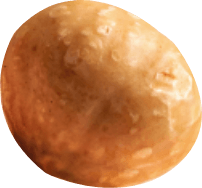
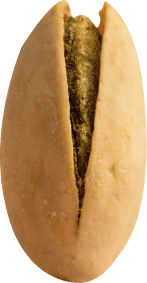
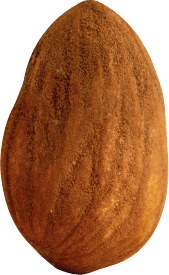
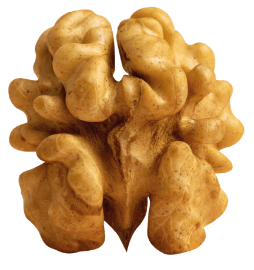
In addition to its traditional value, dried fruit has earned a permanent place in modern eating habits thanks to its properties: it is rich in minerals, fiber, and healthy fats, perfect as a healthy snack and a versatile ingredient in cooking. During the holidays, when rich meals alternate with moments of conviviality, a mix of dried fruit can be a balanced alternative to many ultra-processed desserts. It is no coincidence that more and more people are choosing to give roasted almonds, shelled pistachios, praline hazelnuts, or gourmet mixes as Christmas gifts: it is a good, precious, natural, and always welcome gift. Dried fruit is a discreet but indispensable part of the holidays. It carries with it an ancient heritage and genuine charm, which is renewed in every piece of nougat, every slice of panettone glazed with almonds, every piece of brittle shared with the family.
While everything else changes, dried fruit remains: a symbol of abundance, a wish for prosperity and, above all, a taste of home.
Roasting: the moment when nuts “wake up”
Roasting is not just about heating an ingredient to a high temperature. It is much more than that: it is the stage when nuts develop their characteristic aromas, lose excess moisture, and achieve the ideal crunchiness. Proper roasting enhances the natural oils of the ingredient, giving it an intense aroma and a more rounded and persistent flavor.
But no two roasts are the same. Each nut requires different times, temperatures, and methods. Hazelnuts, for example, react differently than almonds, and pistachios, with their delicacy, require even more attention. Roasting therefore means knowing the material, recognizing the difference between one minute more or less, and knowing how to listen to that slight sound as the nuts move around in the roasting chamber.
Pralining: where technique meets creativity
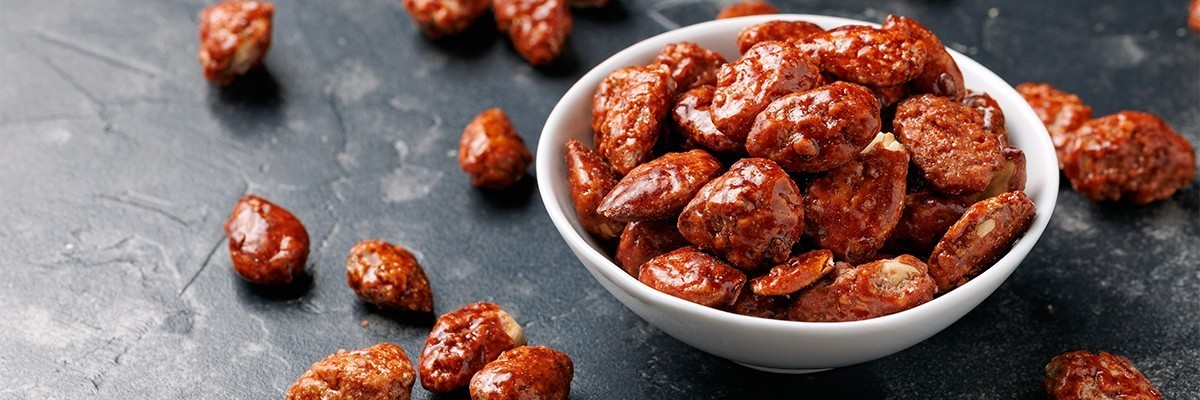
If roasting is the moment when nuts release their character, pralining is the process that gives them a new personality. It is an art that combines sugar, heat, and movement to obtain a crunchy, shiny crust that enhances the flavor of the raw material.
Good pralinage requires skill: managing the sugar during crystallization, controlling the temperature, the speed of rotation of the basins, and the ambient humidity. These elements, when combined, determine the success of the final product.
Here too, it is internal know-how that makes the difference. Pralining “in-house” means being able to modulate the thickness of the sugar crust, obtain different textures—from a rougher, crunchier pralinage to a finer, silkier one—and, above all, work on customization: adding a touch of salt, a hint of vanilla, a spicy or citrusy aromatic profile.
This phase allows us to create unique ingredients, intended for both professional pastry shops and quality industrial production. And this is where know-how manifests itself in its most creative form: not just technical processing, but a true construction of taste.
Grinding: a process that requires patience and precision
Grinding is the final stage in this process, transforming the solid ingredient into a perfect cream or granules. It is a seemingly simple process, but in reality it is extremely complex because it affects the very structure of the ingredient.
Grinding does not simply mean reducing something into pieces. It means obtaining a uniform grain size, avoiding overheating the mass, which could release excessive oils, and keeping the aroma of the nuts intact. It means understanding how the product behaves under pressure, how it reacts to friction, and what consistency is ideal for the final use.
This is where technical know-how becomes sensory expertise: knowing the exact point at which the hazelnut grains reach the ideal crunchiness for a topping.
The value of know-how: the difference you can't see but can feel
In a market that tends to standardize products and flavors, know-how represents a true corporate asset. It is not just technical expertise, but an identity. It is what allows us to tell the story of a product through its processing, to enhance not only the ingredient but also the way it is treated.
Roasting, pralining, and grinding are processes that transform the raw material and at the same time tell a story: that of a company that has chosen to invest in internal control, quality, and artisanal precision even when volumes increase.
These are slow, complex stages that require time and attention, but which add value and uniqueness. Above all, they create trust: the certainty of knowing that every batch, every grain, carries with it the same care and the same level of excellence.
From crunchy to granulated, every transformation is an act of knowledge. Knowledge that not only changes the material, but enhances it, exalts it, and makes it unique.